Cocobi Good Habits -Kid Toilet
- 3.3
- Rating
- 5.00M
- Installs
- Free
- Price
 Analysis by App-foxy
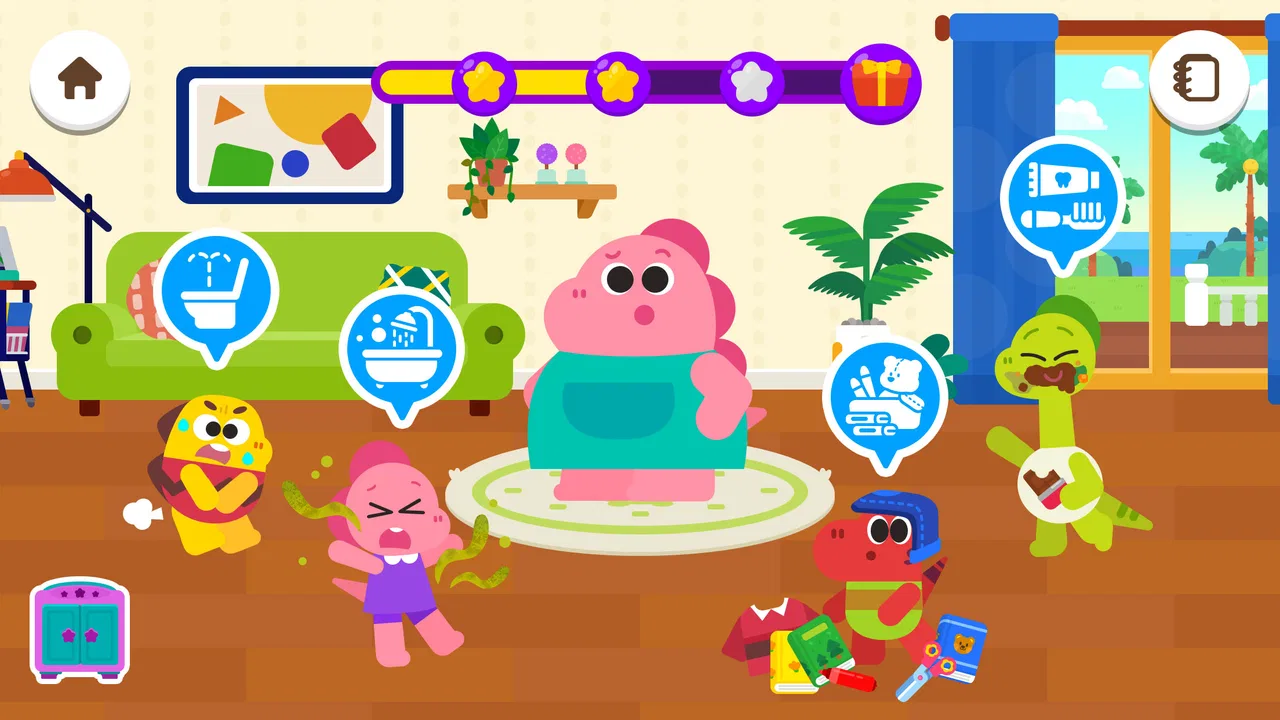
Cocobi Good Habits -Kid Toilet is a small, focused educational game that turns toilet routines into simple play for young children. I see its main value in repetition: rather than trying to explain every step in a long conversation, a parent can use a short game session to make an everyday routine feel more familiar. It is free to start, aimed at Everyone, and comes from KIGLE, the developer behind the Cocobi characters.
My overall view is positive but specific. This is not a broad early-learning platform or a substitute for real guidance from an adult. It works best as a gentle companion for children who are beginning to learn bathroom habits and respond well to colorful dinosaur characters. If you want a large collection of subjects, deeper progression, or a game with substantial challenge for an older child, this will probably feel too narrow.
Learning bathroom routines through short, friendly play
I find it helpful to treat a bathroom-learning game as a prompt for conversation, not a lesson the child has to pass. A relaxed first session can show whether the Cocobi characters make the topic feel approachable, while a parent can connect the play to familiar words and routines at home. That gives us a practical starting point for judging what this focused game does especially well.
You May Also Like

 Blood Strike: 2.5 Anniversary
Blood Strike’s Loadouts Turn Every Drop Into a Tactical Gamble
A close look at Blood Strike’s custom loadouts: how fast access to signature weapons reshapes its battle royale rhythm, rewards preparation, and narrows the gap between fights.

 Pandora - Music & Podcasts
Pandora’s Music Is Easy to Start, but Harder to Recover
Pandora’s strength is its low-effort path from a seed to a station. Its weak spot is how much confidence it asks you to place in connection, setup, and quiet recovery.

 8 Ball Pool
 Is Built on Rivalries, Rematches, and Routine
A close look at the rivalries, rematches, shared routines, and unanswered safety questions that turn a quick pool match into a persistent mobile community.

 Samsung Music
’s Quiet Strength Is Playing What You Already Own
Its reach comes less from spectacle than from dependable access to a personal library. That simplicity is both the app’s strongest retention engine and its ceiling.

 AccuWeather: Weather Radar
AccuWeather Review: A Quick, Clear Forecast for Everyday Decisions
For everyday plans, the best forecast is the one you can understand quickly. AccuWeather makes rain timing, radar, and local conditions easy to act on, with a few trade-offs.

 Hill Climb Racing
Why Hill Climb Racing Still Turns Crashes Into One More Run
A tiny car, a bumpy hill and one more upgrade: Hill Climb Racing keeps resurfacing because its simple chaos makes every near-miss feel personal.
More From Our News Desk



What the game gets right for young children
The strongest part of the experience is its clear subject. The game does not scatter attention across numbers, letters, puzzles, and stories. Its focus is the toilet routine, which makes it easier for a parent to connect play with something happening at home. A child can recognize the situation, watch the characters, and then try to remember the same habits away from the screen.
That connection matters because bathroom learning is less about memorizing information and more about building a sequence. Children often need reminders about what to do before, during, and after using the toilet. A game built around that theme can give those steps a familiar context without making the conversation feel like a correction. In my experience, the best use is to play briefly before a routine, then refer back to the game when the child needs encouragement.
Cocobi’s little dinosaurs are a good fit for this audience. They make an ordinary subject feel less serious and potentially less embarrassing. A child who is reluctant to talk about toilet habits may be more willing to engage when the focus is on helping a friendly character. That emotional distance is useful: the child is not being put on the spot, but is still thinking about a real-life behavior.
The game also benefits from being easy to understand at a glance. Young children do not need a complicated menu or a long explanation before they can begin. That simplicity is important for independent moments, although I would still introduce it with an adult nearby. A child may understand the activity but miss the connection between the on-screen action and the exact routine expected at home.
A practical way to use it during toilet training
A realistic household example would be a parent introducing the game after breakfast, when the child is calm rather than already rushing to the bathroom. I would sit beside the child for the first session, name the actions in everyday language, and then stop before the activity becomes tiring. Later, if the child resists washing hands or needs a reminder, I could mention the dinosaur routine instead of repeating a command.
This approach makes the game a conversation starter rather than a reward that must be earned every time. That distinction is important. If the child only sees the game after completing a task, the screen can become the main motivation. Used more thoughtfully, it helps establish a predictable sequence: notice the need, use the toilet, clean up, and wash hands. The adult still supplies the real-world explanation and supervision.
One useful tip is to keep the device close to the child but not treat it as a bathroom fixture. Playing in a shared space makes it easier to discuss the lesson and avoids turning the phone or tablet into something the child expects during every toilet visit. The game can prepare the child for the routine, while the actual routine remains screen-free.
Another practical tip is to ask the child to explain what the character should do next. This reveals whether the child is following the sequence or simply tapping through familiar images. If the answer is incomplete, I would repeat the relevant part calmly rather than turning the moment into a test. The educational value comes from understanding, not from finishing quickly.
Where it sits among other children’s learning apps
Compared with general preschool apps, this game has a narrower purpose and a more immediate household use. Broad learning collections are better when a child wants variety or when a parent is looking for activities across several developmental areas. Cocobi Good Habits -Kid Toilet is more useful when the specific goal is making bathroom habits less unfamiliar.
It also differs from passive children’s videos. A video can model a routine, but a game invites the child to take part. That small amount of interaction can make the sequence easier to remember. On the other hand, videos may offer longer stories and more emotional context, while this game is likely to feel more like a focused activity. I would choose this title for a short practice moment, not as a replacement for broader play or shared reading.
Compared with printed picture cards, the game is more engaging for children who enjoy tapping and animated characters. Cards are easier to keep available, do not depend on a device, and can be adapted by a parent to match the exact routine at home. The game’s advantage is interest and responsiveness; the cards’ advantage is flexibility. Families who are trying to reduce screen exposure may prefer to use the game once and then recreate the same sequence with pictures or conversation.
The limitations parents should understand
The focused design is also the main weakness. Once a child understands the basic idea, the activity may not offer enough variety to hold attention for long periods. That is not necessarily a problem for a toilet-training tool, because short sessions are more appropriate than extended play here. Still, parents expecting a complete educational game with multiple subjects may find the experience limited.
I would also avoid assuming that an animated routine automatically teaches every child the same thing. Bathroom habits vary by age, ability, family practice, and stage of toilet training. Some children need help with body signals, some need reassurance about using a new toilet, and others need support with clothing or hygiene. A game can reinforce a simple sequence, but it cannot observe what a child is struggling with or adjust its explanation like a patient adult can.
The average rating is 3.4 from around 1.5 thousand ratings, with 20 written reviews, so the public response is mixed rather than universally enthusiastic. I would treat that as a reason to set realistic expectations. The game may fit one child very well and feel repetitive or too basic to another. A rating alone cannot tell me how well it will match a particular child’s attention span, comfort level, or learning needs.
There is also a financial detail worth noticing. The game is free, but in-app purchases are listed at $1.99 per item. I would check the purchase flow before handing the device to a child and make sure the child knows which parts are available without buying anything. For families who want a completely purchase-free experience, that possibility may be a deciding factor even if the starting download costs nothing.
Because the game is aimed at Everyone, it is positioned for a broad young audience, but that does not mean every child will be ready for it at the same time. A toddler who is not yet interested in bathroom routines may simply tap without learning much. An older child who already manages the routine independently may find the subject too immature. The best match is a child at the beginning or middle of learning, especially one who likes character-led activities.
Device fit, access, and everyday expectations
The title is available as a game in the Educational category and supports devices running Android 7.0 or later. That makes it accessible to many older Android phones and tablets, although the experience will still depend on the particular device and how comfortably a young child can hold it. A larger tablet may be easier for shared play, while a phone is more convenient for a quick session.
It has passed one million installs, which suggests that the Cocobi concept has reached a substantial audience. I would not take that alone as proof that it is the right choice for every family, but it does make the game easier to consider as an established option rather than an obscure experiment. The current version is 1.0.16, so I would keep the app updated through the normal store process when possible.
Since it is free to begin, it is reasonable to try it during a calm moment and judge the child’s response before spending anything. I would look for three things: whether the child can follow the sequence, whether the characters reduce anxiety, and whether the child can talk about the routine afterward without needing the device. If only the tapping is enjoyable, a picture book or direct demonstration may be more effective.
Parents should also decide in advance where the game belongs in the daily rhythm. A short session after a routine can reinforce what happened, while a session immediately before bedtime may create another request for screen time. The most useful placement is predictable but limited. I would rather use it for a few minutes with active conversation than leave it running while the child plays without explanation.
Who will benefit most from it
I recommend this game most strongly to parents of preschool-age children who are starting toilet training, feeling uncertain about the process, or needing repeated reminders about hygiene. It can also help caregivers introduce the subject to a child who responds better to characters than to direct instruction. The dinosaur theme gives the conversation a playful entry point without requiring a complicated learning system.
It is particularly suitable for a child who enjoys repeating familiar activities. Repetition is not a flaw in this context; it can be exactly what makes the routine stick. A child may want to revisit the same sequence several times, and that can give the adult opportunities to use consistent words. Consistency between the game, the parent’s explanation, and the real bathroom routine is more important than completing every available activity.
I would be less likely to recommend it as the main choice for families seeking a wide educational package. If the goal is reading practice, counting, drawing, or open-ended creativity, a broader preschool app will provide more value. I would also skip it for a child who is already confident with toilet habits, unless the child simply enjoys Cocobi and the activity is being used as light entertainment.
Children with specific developmental or sensory needs may require more tailored support than a general game can provide. In that situation, I would use the app only if it clearly matches the child’s communication style and never rely on it as the sole teaching method. An adult who knows the child should decide whether the visuals and pace are calming, confusing, or distracting.
My final assessment after weighing the trade-offs
Cocobi Good Habits -Kid Toilet succeeds because it takes a potentially awkward subject and gives it a friendly, manageable shape. Its strongest feature is not complexity; it is focus. The game can help a parent make bathroom routines easier to discuss, especially when a child enjoys the Cocobi dinosaurs and benefits from seeing a sequence acted out.
Its limits are equally clear. The subject is narrow, the experience may become repetitive, and the game cannot replace supervision, explanation, or the child’s real-world practice. The mixed average of 3.4 reflects why expectations matter: this is a specialized helper, not a universal preschool recommendation. The free entry point is useful, but families should remember that individual in-app items cost $1.99 and manage purchases before sharing the device.
My recommendation is to try it as a short, guided activity rather than a digital babysitter. Sit with the child at first, connect the dinosaur’s actions to the routine at home, and gradually see whether the child can describe the steps without looking at the screen. If that transfer happens, the game is doing something worthwhile.
For the right child, this is a gentle bridge between explanation and practice. For families wanting a complete learning library, a screen-free teaching tool, or a more advanced game, another option will be better. But when the immediate need is to make toilet habits feel familiar and less intimidating, KIGLE’s focused approach is sensible, approachable, and worth a careful trial.
FAQs for Cocobi Good Habits -Kid Toilet
01What age group is Cocobi Good Habits - Kid Toilet suitable for?
Cocobi Good Habits - Kid Toilet is designed for young children, typically aged 2 to 6 years old. The app uses colorful animations and engaging activities to teach toddlers essential toilet training and good hygiene habits in a fun and interactive way, making it ideal for preschoolers.
02Does the app require an internet connection to function?
No, Cocobi Good Habits - Kid Toilet does not require an active internet connection once it is downloaded and installed. This makes it convenient for parents and children to use the app anywhere, even in places where internet connectivity might be limited or unreliable.
03Are there in-app purchases or ads in Cocobi Good Habits - Kid Toilet?
Cocobi Good Habits - Kid Toilet is a free app, but it may contain in-app purchases for additional features or content. It is designed to be child-friendly, so ads are minimal or non-intrusive, ensuring a safe environment for children while they learn.
04How does Cocobi Good Habits - Kid Toilet support learning?
The app uses interactive games, songs, and stories to teach children about using the toilet and maintaining good hygiene. It incorporates repetition and rewards to reinforce learning, helping kids develop these habits naturally and with positive reinforcement that encourages continued practice.
05Can multiple children use Cocobi Good Habits - Kid Toilet on the same device?
Yes, multiple children can use the app on the same device. However, the app does not support individual profiles. Parents may need to monitor or assist children to ensure they each get a personalized learning experience according to their individual progress and needs.
Pros
- Engaging animations for kids.
- Easy-to-understand instructions.
- Reward system for motivation.
- Colorful and child-friendly design.
- No in-app purchases needed.
Cons
- Limited language options.
- Content may feel repetitive.
- Requires internet for updates.
- No parental control features.
- Ads can interrupt gameplay.

Cocobi Good Habits -Kid Toilet
Gallery